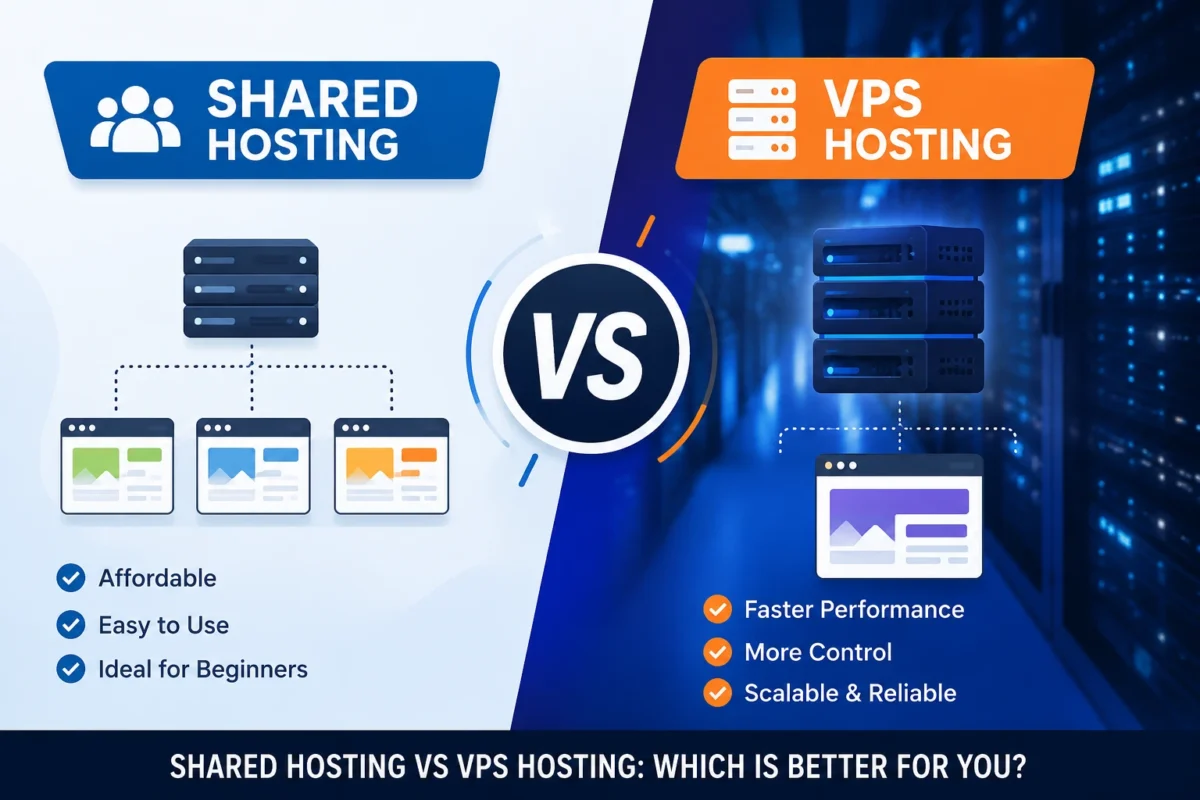
Shared Hosting vs VPS Hosting: Which One Should You Choose?
When creating a website, one of the first things you need is web hosting. Your hosting service stores your website files and makes them available online for visitors.
There are many types of hosting available today, but Shared Hosting and VPS Hosting are two of the most popular options. Many beginners find it difficult to choose between them because both have their own benefits.
In this article, we’ll explain Shared Hosting and VPS Hosting in simple terms. We’ll compare their features, costs, performance, and security so you can decide which one is right for your website.
What Is Shared Hosting?
Shared Hosting is the most common type of web hosting. In this setup, many websites share the same server and its resources.
Think of it like sharing a house with several people. Everyone uses the same electricity, water, and internet connection. In the same way, websites on a shared hosting server use the same CPU, RAM, and storage.
Because the cost is shared among many users, Shared Hosting is usually very affordable.
Benefits of Shared Hosting
- Low monthly cost
- Easy to set up
- Beginner-friendly
- No server management required
- Good for small websites
Drawbacks of Shared Hosting
- Slower during high traffic periods
- Limited server resources
- Less control over server settings
- Performance may be affected by other websites on the server
Shared Hosting is often a great choice for people who are starting their first website.
What Is VPS Hosting?
VPS stands for Virtual Private Server. It uses virtualization technology to create separate environments on a physical server.
Even though multiple VPS accounts may exist on the same physical machine, each VPS gets its own dedicated resources. This means your website has its own portion of CPU, RAM, and storage.
You can think of VPS Hosting as living in your own apartment. You have more privacy, more control, and your resources are not directly shared with other users.
Benefits of VPS Hosting
- Faster website performance
- Dedicated resources
- Better security
- More server control
- Easy to upgrade as your website grows
Drawbacks of VPS Hosting
- Higher cost
- May require some technical knowledge
- More responsibility for server management
VPS Hosting is a popular choice for business websites, online stores, and websites that receive regular traffic.
Shared Hosting vs VPS Hosting: Main Differences
Let’s compare the two hosting types side by side.
1. Performance
Performance is one of the biggest differences between Shared Hosting and VPS Hosting.
In Shared Hosting, resources are shared among many websites. If one website gets a lot of visitors, other websites on the same server may become slower.
With VPS Hosting, your resources are reserved for your website. This provides more stable and reliable performance.
If website speed is important for your visitors and search rankings, VPS Hosting has the advantage.
2. Security
Security should always be a priority.
Shared Hosting providers use security measures to protect their servers, but multiple websites still share the same environment.
VPS Hosting creates a more isolated environment. This separation helps reduce certain security risks and gives website owners more control over their security settings.
For websites that handle customer information or online payments, VPS Hosting is often the safer option.
3. Cost
For many beginners, price is an important factor.
Shared Hosting plans are usually the cheapest option available. Many providers offer plans starting at just a few dollars per month.
VPS Hosting costs more because it provides dedicated resources and better performance.
If you are working with a small budget, Shared Hosting can help you get started without spending too much money.
4. Scalability
As your website grows, you may need more resources.
Shared Hosting has limits. Once your website starts getting more traffic, you may notice slower loading times.
VPS Hosting makes it easier to increase resources when needed. Many providers allow you to upgrade your plan without moving your website to a new server.
This makes VPS Hosting a better long-term solution for growing websites.
5. Server Control
Shared Hosting is designed to be simple. Most server settings are managed by the hosting company.
VPS Hosting gives you more control. You can install software, change configurations, and customize the server based on your needs.
Developers and advanced users often prefer VPS Hosting because of this flexibility.
Which Hosting Is Best for Beginners?
If you are launching your first blog, portfolio website, or small business website, Shared Hosting is usually the best place to start.
It is affordable, simple to manage, and provides everything needed for a new website.
You can always upgrade later when your website grows.
Which Hosting Is Best for Growing Websites?
If your website receives regular traffic or you plan to grow your online business, VPS Hosting is worth considering.
The improved speed, better security, and dedicated resources can provide a better experience for your visitors.
For eCommerce stores and business websites, VPS Hosting is often the smarter investment.
Final Thoughts
Both Shared Hosting and VPS Hosting are good hosting options, but they are designed for different needs.
Choose Shared Hosting if:
- You are a beginner
- You have a limited budget
- Your website is new
- You don’t need advanced server control
Choose VPS Hosting if:
- Your website is growing
- You need faster performance
- Security is important
- You want more control over your server
For most new website owners, Shared Hosting is a great starting point. As traffic and business needs increase, upgrading to VPS Hosting can provide better performance and room for growth.
FAQs
-
Is Shared Hosting good for a new website?
Yes. Shared Hosting is affordable, easy to manage, and suitable for most new websites.
-
Is VPS Hosting faster than Shared Hosting?
Yes. VPS Hosting provides dedicated resources, which usually results in better and more consistent performance.
-
Can I move from Shared Hosting to VPS Hosting later?
Yes. Most hosting providers offer simple upgrade options when your website grows.
-
Which hosting is better for SEO?
Website speed and uptime can affect user experience. VPS Hosting often performs better in these areas, which may help support your SEO efforts.